
Best Control Padel Rackets in 2026

Best Padel Rackets for Control in 2026: Our 5 Recommendations
There is no single best racket for every player. Some prioritise maximum stability and precision, while others want a larger sweetspot, a lighter racket, a firmer response or more help generating power. We have therefore selected five models to suit different control-oriented players. Our recommendations are based on our own on-court testing, customer feedback, experience advising padel players and our specialist knowledge of padel rackets.
5 of the Best Padel Rackets for Control in 2026
All five models have control as a key strength, but they deliver it in different ways. Each racket has therefore received its own award rather than simply being ranked from one to five.
| Model | Our Award | Level | Weight | Balance | Firmness and feel | Head Shape |
|---|---|---|---|---|---|---|
| Best overall | Advanced | Approx. 365 g | Neutral | Soft to medium | Round | |
| Best for control with extra power | Advanced | 365 g | Head-heavy | Firm and responsive | Round | |
| Best for defensive control | Advanced | 365 g | Neutral | Medium to firm | Round | |
| Best for firm response and stability | Advanced | 370 g | Head-light | Firm and direct | Teardrop | |
| Best for a large sweetspot and comfort | Intermediate and above | 360 g ± 8 g | Neutral | Medium and comfortable | Cybershape hybrid |
How We Selected the Best Padel Rackets for Control
A control racket can look good on a specification sheet yet feel completely wrong for an individual player. That is why this list is not based on manufacturers' marketing alone. Our selection combines specialist knowledge, first-hand experience on court, insights gained from advising padel players and the documented information available for each model.
Our Selection Is Based On
How Do We Assess a Control Racket?
What Makes a Good Padel Racket for Control?
A good padel racket for control is defined by far more than its head shape. The shape affects the position and size of the sweetspot, but balance, weight, stability, core and the response of the hitting surface are just as important in determining how precise and confidence-inspiring the racket feels. A low or neutral balance generally makes the racket easier to manoeuvre, while more weight towards the head can add stability and power.
The sweetspot is equally important. A large sweetspot makes a racket more forgiving when contact is not perfectly clean, while a firmer, more precise construction can give technically strong players more direct feedback. This is why two control rackets can feel very different on court. Some models prioritise comfort and ease of use, while others reward accurate timing and clean contact.
You should therefore not choose a control racket based on head shape alone. Consider the entire construction and match it to your level and playing style.
For a more detailed look at head shape, balance, weight, core and materials, read our guide to choosing a padel racket.

Nox ML10 Ventus Control 3K 2026: Best Overall
The Nox ML10 Ventus Control 3K 2026 is our best overall choice for players seeking a strong combination of precision, a large sweetspot, comfort and stability. It is less demanding than the firmest rackets on the list and therefore suits a broader range of advanced players.
Why We Recommend the Nox ML10 Ventus Control 3K 2026
The combination of a round head shape, neutral balance, 3K carbon and HR3 Colour EVA gives the ML10 a classic control-oriented profile. Its large, central sweetspot makes it easier to maintain shot quality, even under pressure when contact is not perfect.
Compared with the Head Radical Pro, ball contact is softer and less direct, so the Nox is less demanding when contact is not perfectly clean. Compared with the Babolat Counter Viper, its weight is distributed more evenly, making it easier to move in defence and during quick exchanges at the net.
In defence, the combination of sweetspot and balance is especially useful. It provides a strong foundation for controlling lobs, blocks and slower shots, while the carbon frame delivers the stability needed as the pace increases.
At the net, the ML10 focuses more on placement and control than outright explosiveness. You can still accelerate the ball, but compared with the Counter Viper, more of the power needs to come from your own swing.
Who Is the Nox ML10 Ventus Control 3K 2026 For?
This racket is particularly well suited to advanced players who build points through precision and want a racket that performs in many different situations. It is especially relevant if you prioritise a large sweetspot, control and comfort over maximum explosiveness.
Who Should Choose a Different Racket?
If you play very aggressively and want more help on overheads, the Babolat Counter Viper 2.6 offers greater attacking power. If you prefer very firm, direct ball contact, the Head Radical Pro 2026 is the better choice.
Strengths
- Large, central sweetspot
- Strong combination of control and comfort
- Even balance provides excellent manoeuvrability
- Well suited to both defensive play and net play
- Relatively forgiving for a top-tier control racket
Things to Consider
- Not the most powerful racket on the list
- You need to generate more of the pace yourself on attacking shots
- Players who prefer very firm feedback may want a stiffer construction
Specifications
| Model | Nox ML10 Ventus Control 3K 2026 |
| Level | Advanced |
| Head Shape | Round |
| Weight | Approx. 365 g |
| Balance | Neutral |
| Firmness | Soft to medium |
| Surface | Dual Spin with texture and a rough finish |
| Surface Material | 3K carbon |
| Core | HR3 Colour EVA |
| Primary Strength | Control, sweetspot and versatility |
| Our Award | Best overall |
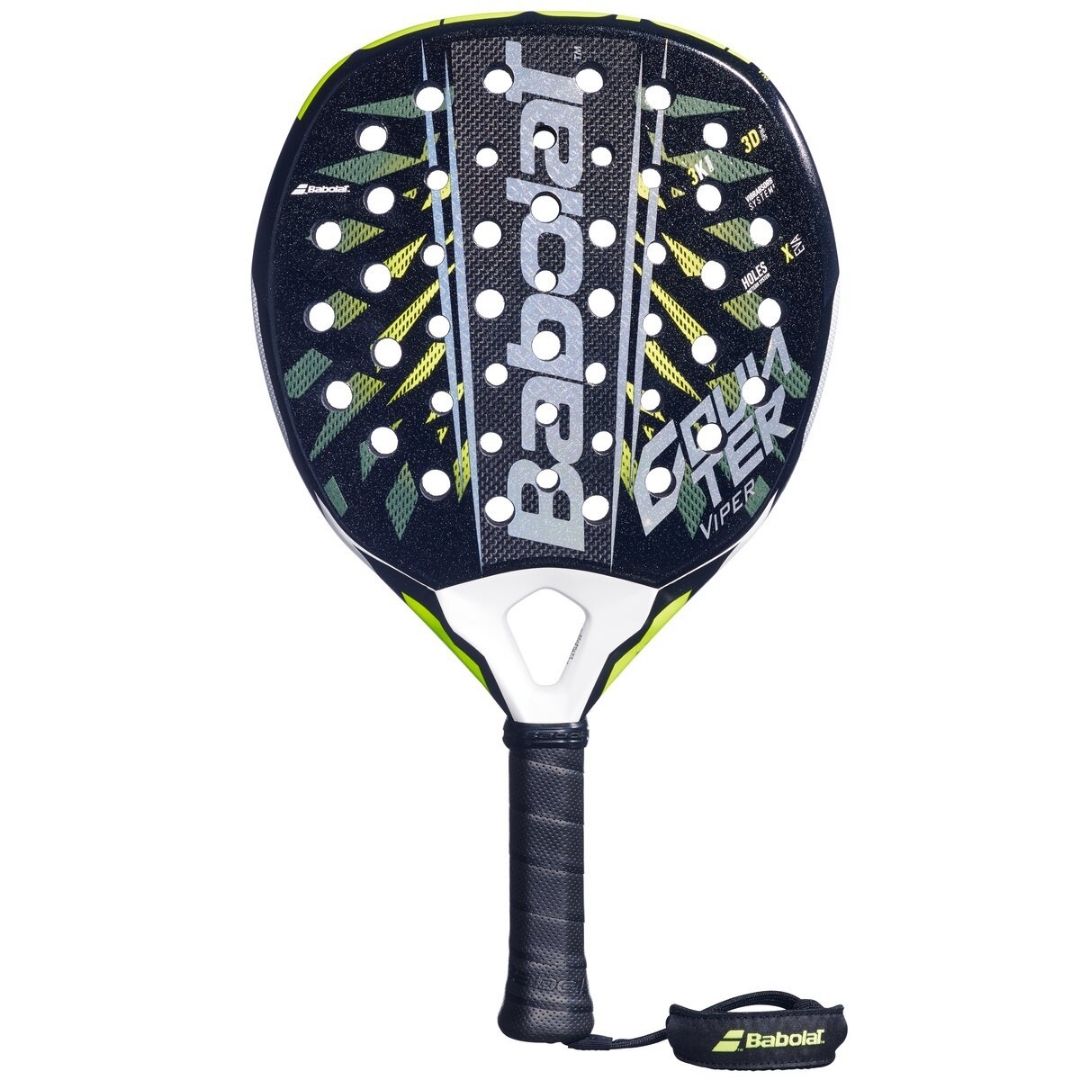
Babolat Counter Viper 2.6: Best for Control with Extra Power
The Counter Viper 2.6 is our choice for players who prioritise control but also want significant attacking power. Its round head shape provides a large hitting area, while the head-heavy balance, 3K carbon and X EVA core deliver greater weight of shot and acceleration than a classic, neutrally balanced control racket.
Why We Recommend the Babolat Counter Viper 2.6
The Counter Viper stands out by combining the precision of a control racket with several qualities normally associated with attacking rackets. Its round shape and large sweetspot improve consistency, while the higher balance point puts more mass behind the ball.
The X EVA core features different densities, while the woven carbon surface provides a firm response. As swing speed increases, the racket delivers a more direct response than the softer models on the list.
In slower defensive situations, the Counter Viper is more demanding than the Nox and Stiga because its head-heavy balance makes it harder to manoeuvre. The additional mass comes into its own when blocking powerful shots or turning defence into attack.
The difference is even clearer at the net. The Babolat provides more effortless power on attacking volleys and overheads than the other control-oriented models. It is therefore a strong choice for players who want to wait for the right ball and then finish the point.
Who Is the Babolat Counter Viper 2.6 For?
The model is best suited to advanced players with solid technique who build points patiently but want to accelerate sharply when an opportunity arises. It is particularly relevant for players who thrive on counter-attacking and like to control the pace themselves.
Who Should Choose a Different Racket?
If you prioritise manoeuvrability and quick reactions over attacking power, the Nox or Stiga will be easier to use. The Counter Viper is also not our first recommendation for players still developing consistent timing and technique.
Strengths
- Greatest attacking power of the five models
- Excellent stability
- Firm and precise response
- Strong choice for counter-attacking play
- Large sweetspot combined with a higher balance point
Things to Consider
- Head-heavy balance makes the model more demanding
- Slower to move than the neutrally balanced alternatives
- Requires better timing than the Nox and Stiga
Specifications
| Model | Babolat Counter Viper 2.6 |
| Level | Advanced |
| Head Shape | Round |
| Weight | 365 g |
| Balance | Head-heavy |
| Firmness | Firm and responsive |
| Surface | Rough surface with 3D Spin |
| Surface Material | 3K woven carbon |
| Core | X EVA |
| Primary Strength | Control combined with power |
| Our Award | Best for control with extra power |

Wilson Endure V1: Best for Defensive Control
The Wilson Endure V1 is designed for players who build their game around control, touch and stability. Its round shape, neutral balance and large sweetspot make it particularly appealing if you want to maintain shot quality throughout long rallies and focus on placement rather than constantly chasing winners.
Why We Recommend the Wilson Endure V1
The Endure V1 sits between the more demanding Endure Pro and the lighter Endure LS. This gives you the stability of a 365-gram racket without moving into the heavier, firmer feel of the Head Radical Pro.
The round Control Geometry construction creates a large sweetspot, while Control Sandwich Foam is designed to provide clear ball contact. It suits players who want to feel the impact while retaining a reasonably forgiving construction.
The Double Y Beam construction in the throat is also designed with stability and manoeuvrability in mind. This is particularly useful when reaction time is limited close to the glass or at the net.
The Endure V1 focuses less on outright finishing power than the Babolat Counter Viper. Its playing profile is better suited to tactical players who win points through consistency, precise placement and reliable defence.
Who Is the Wilson Endure V1 For?
The Endure V1 is particularly well suited to advanced players with a defensive or patient playing style. It is a good choice if you prioritise control, stability, a large sweetspot and dependable performance under pressure.
Who Should Choose a Different Racket?
If you want maximum attacking impact, the Babolat provides more effortless power. If you prefer a more direct and rigid response, the Head is the better choice. If you want an even lighter racket, another model may be more suitable.
Strengths
- Clear focus on defensive control
- Large sweetspot
- Good stability under pressure
- Even balance
- Good combination of feel and ease of use
Things to Consider
- Less explosive than the Babolat Counter Viper
- Not the lightest model on the list
- Highly aggressive players may want more attacking power
Specifications
| Model | Wilson Endure V1 |
| Level | Advanced |
| Head Shape | Round |
| Weight | 365 g |
| Balance | Neutral |
| Firmness | Medium to firm |
| Surface | Textured carbon surface |
| Surface Material | Carbon construction with Raw Carbon technology |
| Core | Control Sandwich Foam |
| Primary Strength | Defensive control and stability |
| Our Award | Best for defensive control |

Head Radical Pro 2026: Best for Firm Response and Stability
The Head Radical Pro 2026 is our choice for technically strong players who want a firm, precise and stable response. At 370 grams, with Double Carbon HS and Control Foam, it is more demanding than the Nox and Stiga but rewards clean contact with very clear feedback.
Why We Recommend the Head Radical Pro 2026
The Radical Pro clearly stands apart from the more comfort-oriented models. Double Carbon HS makes the hitting surface stiffer, while Control Foam provides firmer and more direct ball contact. The result is immediate feedback on both clean and off-centre hits.
At 370 grams, the Radical Pro is also the heaviest of our five recommendations. The extra mass adds stability when facing fast shots and playing blocks, but requires more strength and sound technique over longer matches.
The teardrop-shaped construction distinguishes the Head from classic round control rackets. At the same time, its relatively low balance point helps keep the racket manoeuvrable despite the higher overall weight.
The Head generates power differently from the Babolat. The Counter Viper offers more help through its head-heavy balance, while the Head rewards a full swing and precise contact. The Radical Pro is therefore our most technically demanding recommendation.
Who Is the Head Radical Pro 2026 For?
The Radical Pro is best suited to advanced players with consistent technique who prefer a firm racket and can generate pace through an efficient swing. It is particularly relevant if you want highly precise feedback and excellent stability.
Who Should Choose a Different Racket?
Players who want softer contact or more forgiveness on off-centre hits should choose a more accessible model. Most players will find the Nox or Stiga more comfortable and easier to use.
Strengths
- Firm and very direct response
- Excellent stability when absorbing pace
- Precise feedback for technically strong players
- Solid power on full swings
- Stable construction at the net
Things to Consider
- The 370-gram weight makes the model more physically demanding
- The firm response is less forgiving
- Requires excellent timing to unlock its full potential
Specifications
| Model | Head Radical Pro 2026 |
| Level | Advanced |
| Head Shape | Teardrop |
| Weight | 370 g |
| Balance | Head-light |
| Firmness | Firm |
| Surface | Firm carbon surface |
| Surface Material | Double Carbon HS |
| Core | Control Foam |
| Primary Strength | Firm response, stability and precision |
| Our Award | Best for firm response and stability |

Stiga Cybershape 18K 2: Best for a Large Sweetspot and Comfort
The Stiga Cybershape 18K 2 is the most unconventional control-focused racket in this guide. Its distinctive Cybershape construction creates a large sweetspot positioned high on the face, while its relatively low weight and softer feel appeal to players who prioritise comfort and manoeuvrability.
Why We Recommend the Stiga Cybershape 18K 2
The first thing that sets the Stiga apart from the other models is its head shape. The Cybershape construction places the sweetspot higher on the hitting surface than on a traditional round control racket, giving the racket a distinct feel through contact.
At around 360 grams and with a neutral balance, the Stiga is also lighter than several of the other models in the guide. This makes it appealing at the net and in situations requiring quick reactions.
The hitting surface is made from 18K Carbon Silver Weave, while the model is softer than the Cybershape 18K Hard. This combination makes the 18K 2 more control-oriented and comfortable without losing the precise feel of the carbon surface.
Compared with the Head, the Stiga offers more forgiving contact. Compared with the Babolat, it provides less attacking power but greater manoeuvrability. It therefore makes particular sense for players who want a large sweetspot and are open to a different head shape.
Who Is the Stiga Cybershape 18K 2 For?
The racket suits players who prioritise a large sweetspot, comfort and manoeuvrability. It is particularly appealing if you want a more forgiving feel than the firmest 18K models while retaining the precision of a carbon surface.
Who Should Choose a Different Racket?
If you prefer a classic round head shape and a traditional central sweetspot, the Nox is the better choice. If you want a very firm response, the Head is a better fit, while the Babolat provides more attacking power.
Strengths
- Very large sweetspot
- Lighter than several competitors
- Even balance and excellent manoeuvrability
- Comfortable ball contact
- Crystal Grip surface provides extra grip on the ball
Things to Consider
- The Cybershape head shape feels different from a traditional round racket
- The sweetspot sits higher in the head
- Less attacking power than the Babolat
Specifications
| Model | Stiga Cybershape 18K 2 |
| Level | Intermediate and above |
| Head Shape | Cybershape hybrid |
| Weight | 360 g ± 8 g |
| Balance | Neutral |
| Firmness | Medium, with a more comfortable feel than the Hard model |
| Surface | Crystal Grip with a rough texture |
| Surface Material | 18K Carbon Silver Weave |
| Core | Comfort-oriented foam construction |
| Primary Strength | Sweetspot, comfort and manoeuvrability |
| Our Award | Best for a large sweetspot and comfort |
How the Five Control Rackets Differ
The five models are more than minor variations of the same racket. Differences in balance, weight, core, sweetspot and surface significantly change the playing experience. The table below compares them directly.
| Model | Sweetspot | Response | Manoeuvrability | Power | Technical demands |
|---|---|---|---|---|---|
| Nox ML10 Ventus Control 3K 2026 | Large | Soft to medium | High | Medium | Medium |
| Babolat Counter Viper 2.6 | Large | Firm | Medium | Very high | High |
| Wilson Endure V1 | Large | Medium to firm | High | Medium | Medium |
| Head Radical Pro 2026 | Medium to large | Firm and direct | Medium | High with a full swing | Very high |
| Stiga Cybershape 18K 2 | Very large and high | Medium and comfortable | Very high | Medium | Medium |
Which of the Five Control Rackets Should You Choose?
If you already know which characteristic matters most to you, use this table as a quick decision guide.
| If you prioritise | Choose |
|---|---|
| Best overall combination | Nox ML10 Ventus Control 3K 2026 |
| Largest sweetspot | Stiga Cybershape 18K 2 |
| Firmest and most direct response | Head Radical Pro 2026 |
| Most power among the control rackets | Babolat Counter Viper 2.6 |
| Defensive control | Wilson Endure V1 |
| Manoeuvrability | Stiga Cybershape 18K 2 |
| Most technically demanding model | Head Radical Pro 2026 |
Who Should Choose a Control Racket?
A control racket is particularly relevant for players who prioritise precision and stability over maximum power. This includes defensive players who want to keep more balls in play, as well as experienced tactical players who build points with lobs, chiquitas, blocks and precise volleys.
Control rackets are therefore not just for beginners. Many strong players can generate enough pace themselves and deliberately choose a control-oriented racket for greater consistency and precision.
If you primarily want to dominate with smashes, attacking viboras and aggressive play at the net, consider a more attacking model in our full range of padel rackets. If you are completely new to the sport, a lighter and more forgiving racket will often be a better place to start. In that case, see our padel rackets for beginners.
Read our guide to choosing a padel racket or browse our full range of padel rackets.
Which Padel Racket Is Best for Control in 2026?
Our best overall padel racket for control in 2026 is the Nox ML10 Ventus Control 3K 2026. Its combination of a large sweetspot, neutral balance, comfortable response and excellent control makes it suitable for a wider range of advanced players than the more specialised alternatives.
Choose the Babolat Counter Viper 2.6 if you want more power and are comfortable with a head-heavy construction. Choose the Stiga Cybershape 18K 2 if sweetspot size and manoeuvrability matter most. Choose the Head Radical Pro 2026 if you are technically strong and prefer a firm, direct response. Choose the Wilson Endure V1 if your game is built primarily around defensive stability and precise placement.
The right choice is therefore not simply the racket that appears at the top of the guide. It is the racket that best matches the way you play padel.
Frequently Asked Questions About Padel Rackets for Control
Which Padel Racket Is Best for Control in 2026?
Our best overall choice is the Nox ML10 Ventus Control 3K 2026. It combines a large sweetspot, neutral balance and a relatively forgiving response. However, the best racket for you may be different if you prioritise extra power, a lighter racket or a firmer hitting surface.
What Is the Difference Between a Control Racket and a Power Racket?
A control racket typically prioritises precision, stability and manoeuvrability, while a power racket is designed to provide more pace and weight of shot in attack. Head shape and balance play an important role, but no single specification determines which category a racket belongs to. Learn more in our guide to choosing a padel racket.
Is a Round Padel Racket Always Best for Control?
No. Round padel rackets often have a large, central sweetspot, making them natural control options, but balance, weight, core and surface material are also important. The Head Radical Pro 2026, for example, is teardrop-shaped and still clearly control-oriented.
Which Balance Is Best for Control?
A low or neutral balance is generally easiest to manoeuvre and gives many players a good sense of control. A head-heavy balance can also work in a control racket if you want extra stability and power. The Babolat Counter Viper 2.6 is an example of this type of construction.
Should a Control Racket Be Soft or Firm?
It depends on your level and preferences. A softer construction generally provides more comfort and forgiveness on off-centre contact. A firm control racket offers more direct feedback and can feel highly precise for technically strong players, but places greater demands on timing.
Can Experienced Players Use Control Rackets?
Yes. Many experienced players can generate plenty of pace themselves and therefore choose control rackets for greater precision, stability and consistency when building points. A control racket is not the same as a beginner racket.
Which Control Racket Is Best for Beginners?
None of the five models in this guide was selected specifically as the best option for beginners. New players should generally prioritise a large sweetspot, comfort and a manageable weight. See our padel rackets for beginners for more forgiving models.
Can a Padel Racket Provide Both Control and Power?
Yes. Control and power are not absolute opposites. The Babolat Counter Viper 2.6 is a good example because it combines a large sweetspot and control-oriented head shape with a head-heavy balance and firm construction that can generate more attacking power.
About the Author
Update History
The article has been updated with five selected control rackets from Nox, Babolat, Wilson, Head and Stiga, along with a direct comparison, decision guide and frequently asked questions.


